 The Intersection of Remaining Legal Obligations After Emigration and International Taxation
1. Separating Green Card Acquisition from Nationality Issues
Even if you obtain a U.S. green card, this only means residency status within the U.S., and it does not change your relationship with Korean nationality.
- Renunciation of nationality: Unless you lose Korean nationality or report expatriation, Korean law continues to apply as is.
- Green card holder status: Under U.S. tax law, a green card holder is considered a "U.S. Tax Resident," creating an obligation to report worldwide income.
- Possibility of dual application: Therefore, as long as you maintain Korean nationality, Korean tax law and health insurance law and U.S. tax law can apply simultaneously.
In other words, the misconception that "green card = elimination of legal obligations in Korea" is incorrect.
2. Health Insurance: Domestic Residency Requirements and Overseas Relocation Reporting
Korea's National Health Insurance Act grants eligibility based on domestic residents.
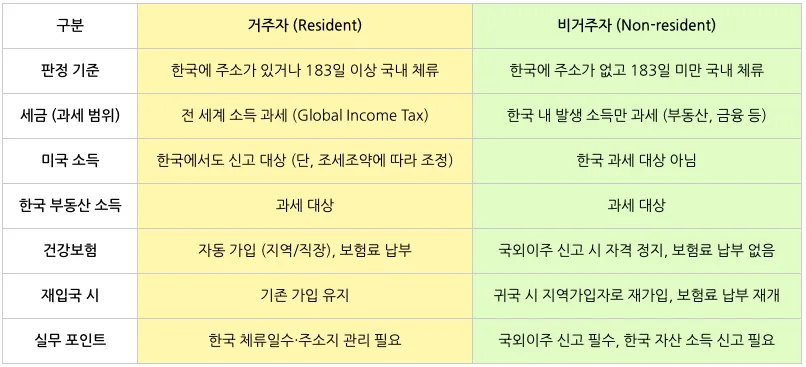
- Resident requirement: If you have resident registration in Korea and actually reside domestically → health insurance eligibility is maintained, and premiums must be paid.
- Long-term overseas residents: If you report overseas residency of 6 months or more → health insurance eligibility is suspended, and there is no obligation to pay premiums.
- Upon re-entry: Immediately upon returning to Korea, you are re-enrolled as a regional subscriber, and premium billing resumes.
Therefore, if a green card holder resides in the U.S., has cleared their Korean address, and has even reported overseas relocation, they do not need to pay health insurance premiums in Korea. However, if you keep an address in Korea and travel back and forth frequently, premiums may continue to be billed as a regional subscriber.
3. Taxes: Distinguishing Between Residents and Non-Residents
Korea's Income Tax Act divides taxpayers into residents and non-residents.
- Resident: If you have an address in Korea or stay for 183 days or more → taxed in Korea on worldwide income (Global Income Tax).
- Non-resident: If you have no address in Korea and stay for less than 183 days → taxed only on income generated within Korea.
In other words, if you obtain a green card, relocate to and live in the U.S., and your days of stay in Korea are less than 183 days, you are classified as a non-resident. In this case, tax is imposed only on income generated in Korea (real estate rental, financial income, etc.), and earned income from the U.S. is not subject to Korean taxation.
4. The Korea-U.S. Tax Treaty and Prevention of Double Taxation
Korea and the U.S. have concluded a Double Taxation Avoidance Agreement (DTA), which stipulates that both countries do not simultaneously impose tax on the same income.
- Earned income: Generated and taxed in the U.S. → not taxed again in Korea.
- Real estate income: Taxed based on the location of the asset → rental or transfer income from Korean real estate is subject to Korean taxation.
- Double taxation prevention mechanism: If income taxed in Korea also becomes subject to U.S. taxation, the tax amount is adjusted through a foreign tax credit.
Therefore, while green card holders must report worldwide income under U.S. tax law, the actual tax burden is coordinated according to the Korea-U.S. tax treaty.
5. Practical Considerations and Risk Management
- Overseas relocation reporting is essential: You must report overseas relocation at your local community center (Jumin Center) to avoid automatic health insurance premium billing and being classified as a resident.
- Managing assets in Korea: Real estate rental/transfer, financial income, etc. are subject to Korean tax law, so they must also be reflected when filing U.S. taxes.
- Managing days of stay: If you stay in Korea for a long period, you may be classified as a resident and taxed in Korea on worldwide income.
- Dual management of tax and insurance: Since you must consider IRS tax law in the U.S. and National Tax Service regulations in Korea at the same time, consulting a tax accountant experienced in international taxation is essential.
Long-Term Immigration Planning Is Necessary
Even after obtaining a green card, as long as you maintain Korean nationality, Korea's tax and health insurance obligations remain in effect.
- Health insurance: Can be suspended upon overseas relocation reporting, resumes upon return to Korea
- Taxes: Residents are taxed on worldwide income, non-residents are taxed only on income within Korea
- Korea-U.S. tax treaty: Double taxation can be adjusted
Therefore, at the same time as obtaining a green card, you must comprehensively manage your address, days of stay, and asset status in Korea, and in the long term, immigration planning that includes tax and insurance strategy is necessary.
Green Card Holders' Obligations in Korea: "Resident vs Non-Resident Comparison"