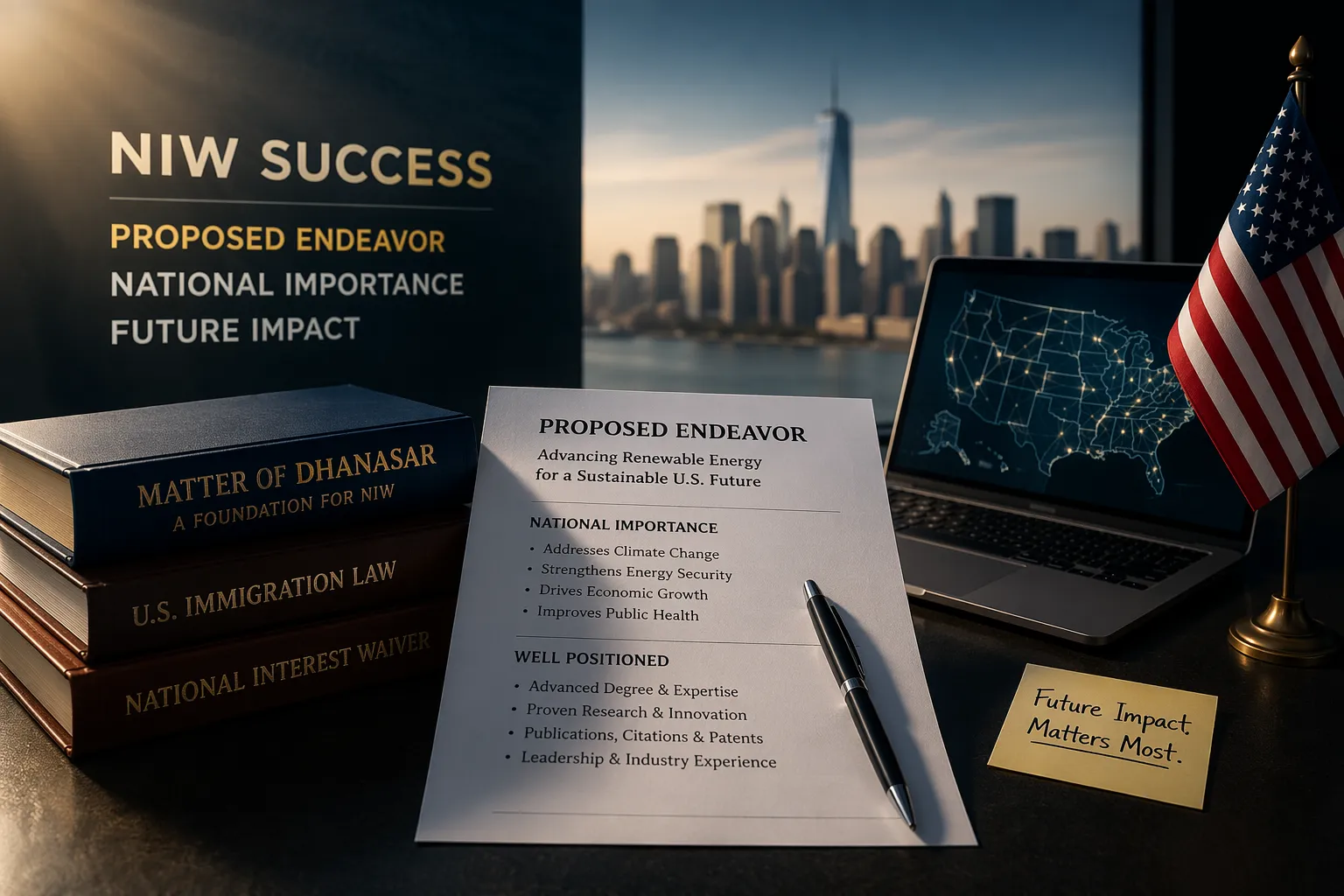
많은 신청자들이 EB-2 NIW를 준비하면서 하나의 단순한 전제를 가지고 접근합니다. 본인의 배경이 충분히 뛰어나면 승인은 자연스럽게 따라온다는 생각입니다. 고학력, 논문, 인용 수, 특허, 그리고 경력 연수 등이 결정적인 요소로 여겨집니다. 그러나 이러한 인식은 정확하지 않습니다. NIW는 단순히 이력이나 성과를 평가하는 제도가 아닙니다. 이는 개인의 활동이 미국에 어떤 이익을 가져올 것인지에 대한 미래 지향적인 판단입니다. 과거의 성과는 중요하지만, 그것이 명확하게 정의되고 전략적으로 구성된 Proposed Endeavor를 뒷받침할 때에만 의미를 가집니다. 이 차이를 이해하지 못하는 경우, 충분히 경쟁력 있는 프로필임에도 불구하고 거절되는 사례가 발생합니다.
■ Proposed Endeavor의 역할
모든 NIW 청원은 Matter of Dhanasar 판례에서 제시된 기준에 따라 평가됩니다. 첫 번째 요건은 Proposed Endeavor가 실질적인 가치와 국가적 중요성을 갖추고 있는지를 보는 것이며, 두 번째 요건은 신청자가 해당 계획을 실제로 수행할 수 있는 위치에 있는지를 평가하는 것입니다. 대부분의 신청자들은 두 번째 요건에 집중하여 자신의 학력, 성과, 경력 등을 강조하는 데 많은 노력을 기울입니다. 그러나 심사는 그 지점에서 시작되지 않습니다. NIW는 Proposed Endeavor에서 출발합니다. 이 계획이 모호하거나 구체성이 부족하거나, 미국의 정책적 방향성과 명확히 연결되지 않는 경우, 심사는 초기 단계부터 어려움을 겪게 됩니다. 아무리 높은 인용 수나 많은 특허를 보유하고 있더라도, 첫 번째 요건을 충족하지 못하면 이를 보완할 수 없습니다. 심사관은 먼저 신청자가 미국에서 무엇을 할 것인지, 그리고 그 활동이 왜 국가적 차원에서 의미가 있는지를 이해해야 합니다. 이러한 기반이 마련되지 않으면, 나머지 자료들은 설득력을 얻기 어렵습니다.
■ 뛰어난 프로필도 거절되는 이유
수천 회 이상의 인용 수를 보유하거나, 다수의 논문과 산업 경험을 가진 신청자들이 거절되는 사례는 결코 드물지 않습니다. 이러한 경우 문제는 배경의 부족이 아니라, 그 배경이 Proposed Endeavor와 명확하게 연결되지 않는 데 있습니다. CV는 과거에 무엇을 해왔는지를 설명하지만, NIW는 앞으로 무엇을 할 것이며 그것이 왜 미국에 중요한지를 입증할 것을 요구합니다. Proposed Endeavor가 특정 분야에서 계속 활동하겠다는 수준으로 지나치게 넓게 설정되거나, 특정 고용주에게만 이익이 되는 형태로 지나치게 좁게 설정되는 경우, 국가적 중요성 기준을 충족하지 못하게 됩니다. 아무리 뛰어난 성과를 가진 경우라도, 이를 국가적 맥락으로 확장하지 못하면 동일한 문제가 발생할 수 있습니다.
■ NIW에서 Proposed Endeavor의 핵심 의미
강한 Proposed Endeavor는 단순히 미래 계획을 설명하는 수준을 넘습니다. 이는 명확한 방향성을 제시하고, 국가적 차원의 문제를 정의하며, 신청자의 활동이 그 문제 해결에 어떻게 기여할 수 있는지를 설명합니다. 이러한 구조가 있어야 심사관은 신청자의 배경과 Dhanasar 기준을 연결할 수 있습니다. 과거 성과를 기반으로 판단하는 두 번째 요건은 첫 번째 요건이 충족된 이후에야 비로소 의미를 가집니다. 중요한 질문은 단순히 신청자가 능력이 있는가가 아니라, 국가적으로 중요한 특정 계획을 실제로 추진할 수 있는 위치에 있는가입니다. 이러한 관점에서 Proposed Endeavor는 청원의 일부 요소가 아니라, 전체 케이스를 지탱하는 구조라고 볼 수 있습니다.
■ NIW 접근 방식의 재정립
성공적인 NIW 청원은 성과 목록에서 시작되지 않습니다. 미국의 필요와 연결된 명확한 Proposed Endeavor에서 시작되며, 이후 신청자의 배경은 해당 계획을 실현할 수 있는 근거로 제시됩니다. 이는 접근 방식의 전환을 요구합니다. 단순히 본인의 자격이 충분한지를 묻는 것이 아니라, 신뢰할 수 있고 국가적 중요성을 갖춘 방향을 제시할 수 있는지가 더 중요한 질문이 됩니다. NIW는 과거의 성과를 보상하기 위한 제도가 아니라, 미래의 기여 가능성을 평가하기 위한 제도입니다.
■ 결론
강한 배경은 NIW에서 여전히 중요한 요소입니다. 그러나 그것이 결정적인 요소는 아닙니다. 최종 결과는 Proposed Endeavor가 Dhanasar 기준을 충족하도록 얼마나 명확하게 설계되었는지에 따라 크게 달라집니다. 이러한 구조가 없다면 아무리 뛰어난 신청자라도 거절될 수 있으며, 반대로 전략적으로 정렬된 Proposed Endeavor는 비교적 평범한 프로필도 충분히 설득력 있는 케이스로 만들 수 있습니다. 이 차이를 이해하는 것이 강한 NIW 전략과 그렇지 않은 전략을 구분하는 기준이 됩니다.
------------------------------------------
NIW Is Not Decided by Your CV
Many applicants approach the EB-2 National Interest Waiver with a simple assumption. If their background is strong enough, approval will follow. Advanced degrees, publications, citations, patents, and years of experience are seen as the deciding factors. This belief is not accurate. The NIW is not a credential-based category. It is a forward-looking analysis of whether an individual’s work will benefit the United States. Past accomplishments matter, but only to the extent that they support a clearly defined and strategically positioned proposed endeavor. This distinction is where many otherwise strong cases fail.
■ The Role of the Proposed Endeavor
Every NIW petition is evaluated through the framework established in Matter of Dhanasar. The first prong requires that the proposed endeavor has substantial merit and national importance, while the second prong evaluates whether the petitioner is well positioned to advance that endeavor. Most applicants focus heavily on the second prong and invest significant effort into documenting their background, achievements, and recognition. However, the analysis does not begin there. The petition begins with the proposed endeavor. If the endeavor is vague, poorly defined, or not clearly aligned with U.S. priorities, the case struggles from the outset. No amount of citations or patents can compensate for a weak showing under the first prong, because the officer must first understand what the applicant intends to do in the United States and why that work matters at a national level. Without that foundation, the rest of the petition carries limited weight.
■ Why Strong Profiles Still Get Denied
It is not uncommon to see applicants with thousands of citations, extensive publication records, or significant industry experience receive denials. In many of these cases, the issue is not the strength of the background but the lack of a clear connection between that background and a well-defined proposed endeavor. A CV explains what you have done, but the NIW requires you to demonstrate what you will do and why it matters to the United States. When the proposed endeavor is framed too broadly, such as continuing general work in a field, or too narrowly, such as work that primarily benefits a single employer, it fails to meet the national importance standard. Even highly accomplished individuals can encounter this issue if their work is not translated into a broader national context.
■ The Proposed Endeavor as the Core of the Case
A strong proposed endeavor does more than describe future work. It establishes a clear direction, identifies a problem of national relevance, and explains how the applicant’s efforts will contribute to addressing that problem. This is what allows the officer to connect the petitioner’s background to the Dhanasar framework. The second prong, which draws from past accomplishments, only becomes meaningful once the first prong is satisfied, because the question is not simply whether the applicant is qualified, but whether they are well positioned to advance a specific endeavor that carries national importance. In this sense, the proposed endeavor is not just one component of the petition, but the structure that supports the entire case.
■ Reframing How to Approach NIW
The most effective NIW petitions do not begin with a list of achievements. They begin with a clearly articulated proposed endeavor that aligns with identifiable needs in the United States, and the petitioner’s background is then presented as evidence that they are capable of advancing that endeavor. This requires a shift in perspective. Instead of asking whether your qualifications are strong enough, the more important question is whether you can define a path forward that is both credible and nationally relevant. The NIW is not designed to reward past success, but to evaluate future contribution.
■ Final Thought
A strong background will always be an important part of an NIW petition, but it is not the deciding factor. The outcome often depends on whether the proposed endeavor is crafted in a way that clearly satisfies the Dhanasar framework. Without that, even highly accomplished applicants can face denial, while a well-structured and strategically aligned proposed endeavor can make an otherwise moderate case significantly more persuasive. Understanding this distinction is what separates a strong NIW strategy from a weak one.

